
Criminal Court Records in Panola County
A Panola County criminal court record is the official case file a court clerk opens the moment formal charges are filed against a defendant. It is a running history of everything the court does with the case: the charging document, every motion, each hearing date, the plea entered, the judge's orders, the outcome, and the punishment. For felonies, the Circuit Clerk maintains the general docket, the minute books, and a permanent record of judgments and executions, so the file that matters most in serious cases sits with the Circuit Court. The record is case-level, not arrest-level, which is the key distinction many searchers miss.
Several courts produce criminal records here, and each handles a different slice of a case. The Circuit Court is the felony court and the venue for major prosecutions, appeals from lower courts, and the final sentencing orders. Justice Court handles misdemeanors in unincorporated areas, traffic citations from the Highway Patrol and Sheriff's Department, and the early felony steps such as initial appearances, bail, and preliminary hearings. The municipal courts in Batesville, Como, and Sardis hold city misdemeanor and city traffic files. A felony usually starts at the Justice Court level, then moves to the grand jury and Circuit Court once charging procedures support prosecution.
The booking record that the Sheriff publishes is a separate document from the court case file, and the Panola County Sheriff's Office is where that charge origin begins. The image below shows the official Sheriff page that anchors the county's booking and roster tools.
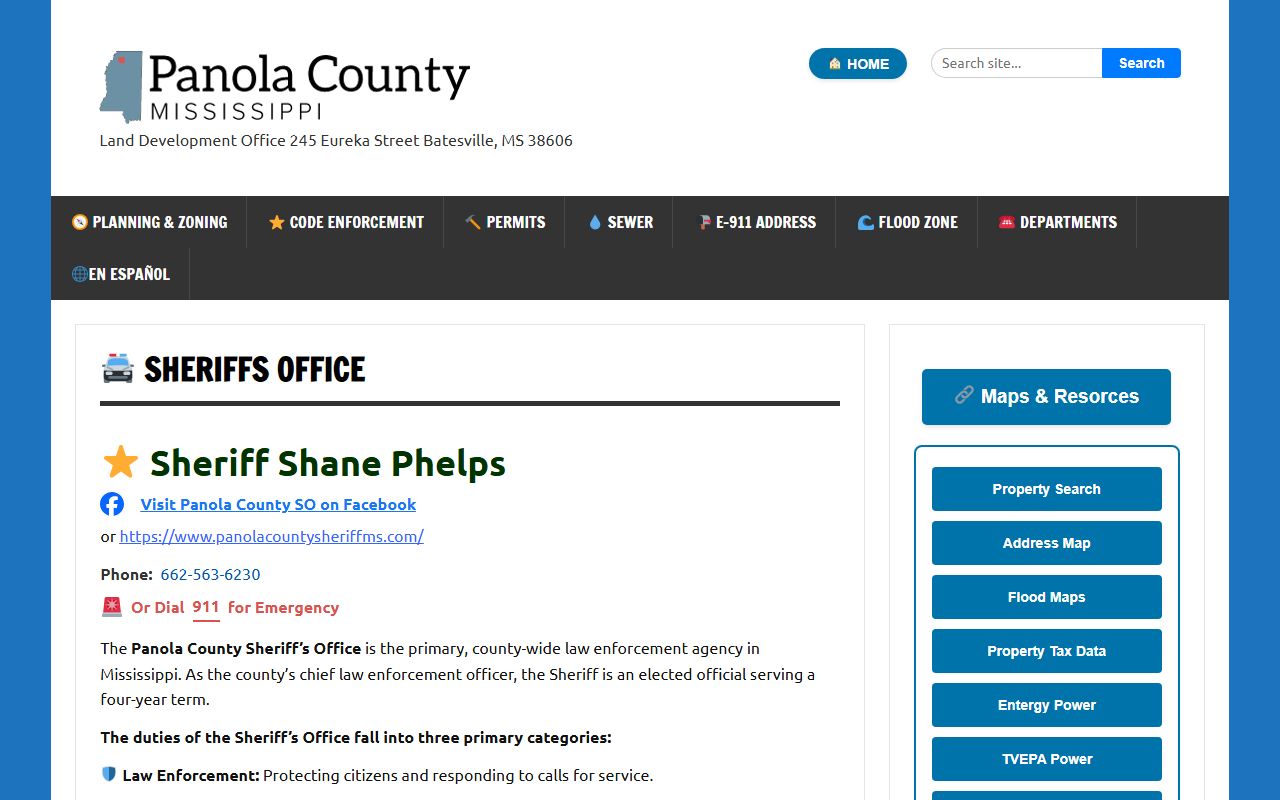
A booking charge listed on the Sheriff roster is not an indictment, a plea, a disposition, or a sentence. It records what a person was arrested and held on, while the Circuit Court file records what the prosecutor actually charged and how a judge resolved it. For the arrest-side detail and the charges themselves, the Panola County court charge records page tracks that pathway, and the booking entries appear on the inmate roster.
How to Search Panola County Criminal Court Records
Panola County has no single free anonymous case-search box. Circuit Court records are tied to Mississippi Electronic Courts (MEC) and its public viewer, PAMEC. Panola County sits in the Seventeenth Circuit Court District, with the First District court in Sardis and the Second District court in Batesville. Public viewers register for a PAMEC login, then sign in through the Seventeenth Circuit MEC site to read filed documents and case information.
- Register for public viewing access at the PAMEC online registration site if you do not already have a login.
- Sign in at the Seventeenth Circuit MEC login using your PAMEC username and password.
- Search by defendant name or case number, and note the district, since First District is Sardis and Second District is Batesville.
- Open the case to read the docket entries, the charging document, and the disposition or sentencing order.
- Request a certified copy from the Circuit Clerk if you need a court-accepted version, since online copies are not certified.
Older files may predate electronic coverage. MEC went live for both Panola Circuit locations on December 18, 2023, with mandatory e-filing beginning January 1, 2024, so cases before that window often require a call or visit to the Circuit Clerk. Justice Court and municipal criminal records are not posted online and must be requested from the Justice Court Clerk or the relevant city court. There is no statewide public criminal-history portal for casual searches, so the clerk of the court that heard the case remains the official source.
Stages of a Criminal Case
A felony case moves through fixed steps, and each one leaves an entry in the court record. The early steps often happen at Justice Court, while the indictment, plea, trial, disposition, and sentence are Circuit Court events. Reading the docket in order shows exactly where a case stands and what the court has decided so far.
Case flow: Charges Filed › Arraignment › Pretrial / Motions › Plea or Trial › Disposition › Sentencing
| Stage | What Happens |
|---|---|
| Charges Filed | A grand jury returns an indictment, or the prosecutor files an information, formally opening the Circuit Court case file. |
| Arraignment | The defendant hears the charges and enters a plea of guilty, not guilty, or no contest, and bond conditions are confirmed. |
| Pretrial / Motions | The parties file motions, exchange discovery, request continuances, and the court sets hearing and trial dates on the docket. |
| Plea or Trial | The case ends in a negotiated plea or proceeds to a bench or jury trial that produces a verdict. |
| Disposition | The record shows the outcome of each charge, whether convicted, acquitted, dismissed, or otherwise resolved. |
| Sentencing | After a conviction the judge enters a sentencing order with confinement, probation, restitution, fines, and court costs. |
Felony prosecution in Circuit Court is handled by the District Attorney for the Seventeenth District, Jay Hale, whose office covers Panola, Tallahatchie, Tate, and Yalobusha counties. A defendant who cannot afford a lawyer is entitled to appointed counsel, and the statewide source for indigent defense is the Mississippi Office of State Public Defender. Justice Court may set bail and hold preliminary hearings, but the felony charge, plea, and sentence belong to the Circuit Court file.
What a Panola County Criminal Court Record Shows
A criminal case file is read field by field. The Circuit Court record can include the indictment or information, arraignment entries, bond orders, motions, plea petitions, sentencing orders, probation terms, restitution, court costs, judgments, post-trial motions, appeals, and any capias or warrant entries. The table below breaks down the core fields and what each one tells a reader about the case.
| Field | What It Shows |
|---|---|
| Case Number | The unique court identifier for the file, tied to the judicial district where the case was filed. |
| Defendant | The person charged, along with attorney names and the assigned Circuit judge. |
| Charges | The offenses as filed in the indictment or information, listed with Mississippi Code citations and severity. |
| Plea | The defendant's answer to each charge, such as guilty, not guilty, or no contest. |
| Docket Entries | The dated, chronological list of every filing, hearing, motion, and order in the case. |
| Disposition | The current or final outcome of each charge, including conviction, dismissal, or acquittal. |
| Sentence | The punishment ordered after conviction, including confinement, probation, restitution, fines, and costs. |
Some details are kept out of the public version on purpose. The MEC rules direct filers to leave Social Security and taxpayer-identification numbers, dates of birth, names of minor children, financial-account numbers, and home addresses out of filings except where the law allows. That redaction baseline means a public criminal record may show less personal data than the underlying paperwork the clerk holds.
Charges vs. Convictions
Being charged is not the same as being convicted, and a criminal court record can show charges that were later dropped, dismissed, reduced, or that ended in an acquittal. A charge is an accusation that opens the case, while a conviction is a verdict or plea that closes a charge against the defendant. Reading the disposition field, not the charge field, is the only reliable way to learn how a case actually ended.
| Charge | Conviction | |
|---|---|---|
| Stage | Accusation | Verdict or plea |
| Burden of Proof | Probable cause | Beyond reasonable doubt |
| Where It Appears | Indictment or information | Disposition and sentencing order |
| Public Record | Yes | Yes |
This matters most when comparing a Sheriff booking entry to the court file. A booking charge reflects what officers held a person on, but the prosecutor may file different counts, amend them, or drop them before trial. The court file, read through to the disposition, is the authoritative record of what a charge became.
Reading Dispositions and Sentences
The disposition is the outcome line, and the sentence is the punishment that follows a conviction. A few terms appear again and again in Panola criminal files, so knowing them makes a record far easier to read. The definitions below cover the words most likely to confuse a first-time searcher.
- Disposition
- The final or current outcome of a charge or case, such as guilty, not guilty, or dismissed.
- Nolo contendere
- A no-contest plea where the defendant accepts punishment without formally admitting guilt.
- Dismissed with or without prejudice
- With prejudice bars refiling the charge, while without prejudice may allow it to be brought again.
- Probation
- Supervised release in the community under court-ordered conditions, often in place of confinement.
- Restitution
- Money the court orders a defendant to pay to repay a victim for loss.
- Capias
- A court order to arrest a defendant, often issued after a failure to appear.
A sentencing order ties these together. It typically states the years of confinement, any portion suspended, the probation term, the restitution and fines owed, and the court costs assessed. When a charge ends in dismissal or acquittal, no sentence follows, and the disposition line stands as the final word on that count.
Note: A single case can carry several charges with different dispositions, so check the outcome of each count rather than assuming the whole file shares one result.
Sealed vs. Expunged Records
Sealing and expunction both restrict access, but they are not the same thing. A sealed record is hidden from ordinary public view while still existing in the system, while an expunged record is treated as if the case never happened. Mississippi Code Section 99-19-71 allows petition-based expunction for eligible cases, including arrests where the person was released and the case dismissed, charges were dropped, no disposition occurred, or the person was found not guilty, plus certain misdemeanor and limited felony convictions when statutory conditions are met.
| Sealed | Expunged | |
|---|---|---|
| Visibility | Hidden from public | Destroyed or treated as never existed |
| Law Enforcement | Limited access | Very limited |
| Eligibility | Juvenile, adoption, and court-restricted matters under Mississippi law | Dismissed, acquitted, non-disposed, and certain misdemeanor or limited felony cases under Section 99-19-71 |
The practical path to expunction starts by identifying the court of conviction or case origin. A petitioner files under Mississippi Code Section 99-19-71, gives notice to the prosecutor or agency as required, pays any filing costs unless waived, and waits for a judge's order. If the court grants it, the clerk and affected agencies update their public records to match. Panola County does not publish a local expunction packet or fee, so the Circuit Clerk, Justice Court Clerk, municipal court, or defense counsel is the right contact depending on where the case originated.
Public Access to Criminal Court Records
Mississippi treats public records as open for inspection unless another law provides otherwise, and that policy starts with the Public Records Act. Criminal case files are also shaped by court rules, confidentiality statutes, and clerk procedures, so the practical rule in Panola County is to ask the office that holds the record. Circuit Court files route through the Circuit Clerk and MEC, Justice Court files through the Justice Court Clerk, and city tickets through the municipal court.
Key Statutes:
Mississippi Code § 25-61-1 - State policy makes public records available for inspection unless another law restricts them.
Mississippi Code § 99-19-71 - Eligible dismissed, acquitted, non-disposed, and certain conviction records may be expunged by petition.
For electronic Circuit Court access, the MEC and PAMEC login is central, and there is no free anonymous county case-search portal. Certified copies, older paper files, and district-specific records require contacting the Circuit Clerk directly. All of these criminal files are part of the broader county system covered on the Panola County court records page, which maps each record type to the office that maintains it.
Background Check Considerations
A casual look at a criminal court record is not the same as a regulated background check. Court files read through MEC, a clerk's office, or a public viewer are useful for personal knowledge, but they are not certified consumer reports. Employment, tenant, credit, and licensing decisions are governed by the Fair Credit Reporting Act, which sets accuracy and notice rules that ordinary record lookups do not meet.
Important: Court records read through a public portal are not a consumer report under the Fair Credit Reporting Act and may not be used for credit, employment, tenant, insurance, or other FCRA-regulated decisions.
Restricted Criminal Court Records in Panola County
Not every criminal-related record is open. Youth Court records and records involving children are confidential under Mississippi Code Sections 43-21-251 and 43-21-261, which limit disclosure to authorized officials, guardians ad litem, and people named by a youth-court order. Juvenile delinquency and child-welfare matters should not be treated like ordinary public criminal files.
Sealed and expunged criminal cases are also outside ordinary public access, and a successful expunction changes what appears in clerk, law-enforcement, and public-facing systems. Pending matters, grand-jury materials, and any document a judge orders withheld may be unavailable while a case is active. When a file is restricted, the redacted public version may show only basic case data, and full access depends on eligibility or a court order from the proper court.
Note: If a record involves a minor, an adoption, a mental-health commitment, or an expunged case, expect the public copy to be limited, redacted, or withheld entirely.