
Panola County Arrest Records and Court Charges
A Panola County arrest record is the law enforcement account of an arrest: who was taken into custody, when the booking happened, and the initial charges officers listed at intake. The Panola County Sheriff's Office, led by Sheriff Shane Phelps, books people into the county jail and records that booking information. An arrest by itself does not file a case in court. Once someone is arrested, a prosecutor reviews the facts and decides the formal charges. In felony matters that prosecutor is District Attorney Jay Hale, who serves the Seventeenth District covering Panola, Tallahatchie, Tate, and Yalobusha counties. The charges he files with the court clerk become the court charge record.
The arrest record and the charge record answer different questions. The booking side stays with the Sheriff and shows custody detail such as the booking number and the charge listed at intake; the Panola County inmate records page covers the jail roster and that booking information. The charge record is what the prosecutor actually filed, and it is tracked through the case as it moves between courts. Court charges after arrest can change, get added, or fall away entirely before a case ends. The complete case file, including pleas, disposition, and any sentence, sits in the Panola County criminal court records.
How to Find Panola County Arrest Records and Charges
Panola County does not run a single free search box for arrest and charge records. Where you look depends on the court. Felony charges and major criminal cases sit in Circuit Court, and those electronic records are reached through Mississippi Electronic Courts. Public viewers register for PAMEC and then sign in to the Seventeenth Circuit system to read filed charges and case events. Booking charges from the arrest itself come from the Sheriff, not the court, so the jail roster is the place to confirm an intake charge.
- Register for a PAMEC viewing account through the Mississippi Electronic Courts registration page.
- Sign in to the Seventeenth Circuit MEC system for Panola County felony and circuit cases.
- Search by the defendant's name or by case number, then open the matching case.
- Read the charge list, and check each charge's statute code, severity level, and current status.
For charges that predate electronic coverage, or for certified copies, call the Circuit Clerk in Batesville at 662-563-6210. Justice Court and the municipal courts handle lower-level charges and do not publish an online case search, so those require a call to the clerk. Statewide criminal history does not roll up into one free public portal in Mississippi, so confirm serious charges directly with the court that heard them.
How Charges Get Filed After an Arrest: Complaint, Information, and Indictment
The court charge record begins when a prosecutor files a charging document. An arrest gives officers probable cause to hold someone, but a charging document is what formally accuses a person in court and starts the case. Mississippi uses three main charging documents, and which one appears depends on how serious the offense is and how the case reached the court.
| Complaint | Information | Indictment | |
|---|---|---|---|
| Filed By | Officer / Prosecutor | Prosecutor | Grand Jury |
| Common For | Misdemeanors | Some felonies | Serious felonies |
| What It Is | A sworn accusation that opens a lower-court case | A prosecutor's formal charge used in certain procedures | A felony charge voted by a grand jury |
| Starts | The case | The case | The case |
Note: A complaint can start a misdemeanor case, but most Panola County felonies proceed to Circuit Court only after a grand jury returns an indictment.
From Booking to Circuit Court in Panola County
A felony charge usually travels a set path in Panola County before it reaches its final court. The arrest and booking happen first at the county jail. Justice Court then handles the early steps, and serious cases move up to Circuit Court for prosecution. The common flow runs Arrest and Booking, then Justice Court initial appearance, bond, and preliminary hearing, then grand jury review, then indictment and prosecution in Circuit Court.
Justice Court judges set bail, hold initial appearances, and conduct preliminary hearings, but they do not try felonies. If a grand jury returns an indictment, the District Attorney prosecutes the case in Circuit Court. A booking charge shown at the jail is not the same as an indictment, a plea, or a conviction, and the wording can read very differently by the time the charge reaches Circuit Court.
What a Panola County Booking Charge Entry Shows
The Sheriff's roster shows charge fields at the booking stage, and those fields often feed the later court charge record. A single arrest can list more than one charge, each with its own description and code. The roster does not show bond, court date, or the arresting agency.
| Field | What It Shows |
|---|---|
| Booking Number | Intake number in a year-prefixed format, such as 2026000941. |
| Booking Date and Time | When the arrest was processed, in MM/DD/YYYY and HH:MM:SS. |
| Charge Description | Plain-language charge, such as Aggravated Domestic Violence or DUI First Offense. |
| Charge Code | The Mississippi Code section tied to the charge, such as 97-3-7(4). |
| Charge ID | A local numeric identifier for each separate charge listed. |
| Identity Fields | Name, date of birth, race, and gender of the person booked. |
Note: A booking charge listed at the jail reflects the arrest, not the final filed charge, and a prosecutor can change or drop it before any court date.
Bench Warrants and Failure to Appear
When a charged person misses court or violates the terms of a sentence, the court can issue a bench warrant, and that warrant becomes its own charge-related record. The Sheriff publishes a curated list of wanted people through its mobile app, drawn from an official Most Wanted data feed tied to the county.
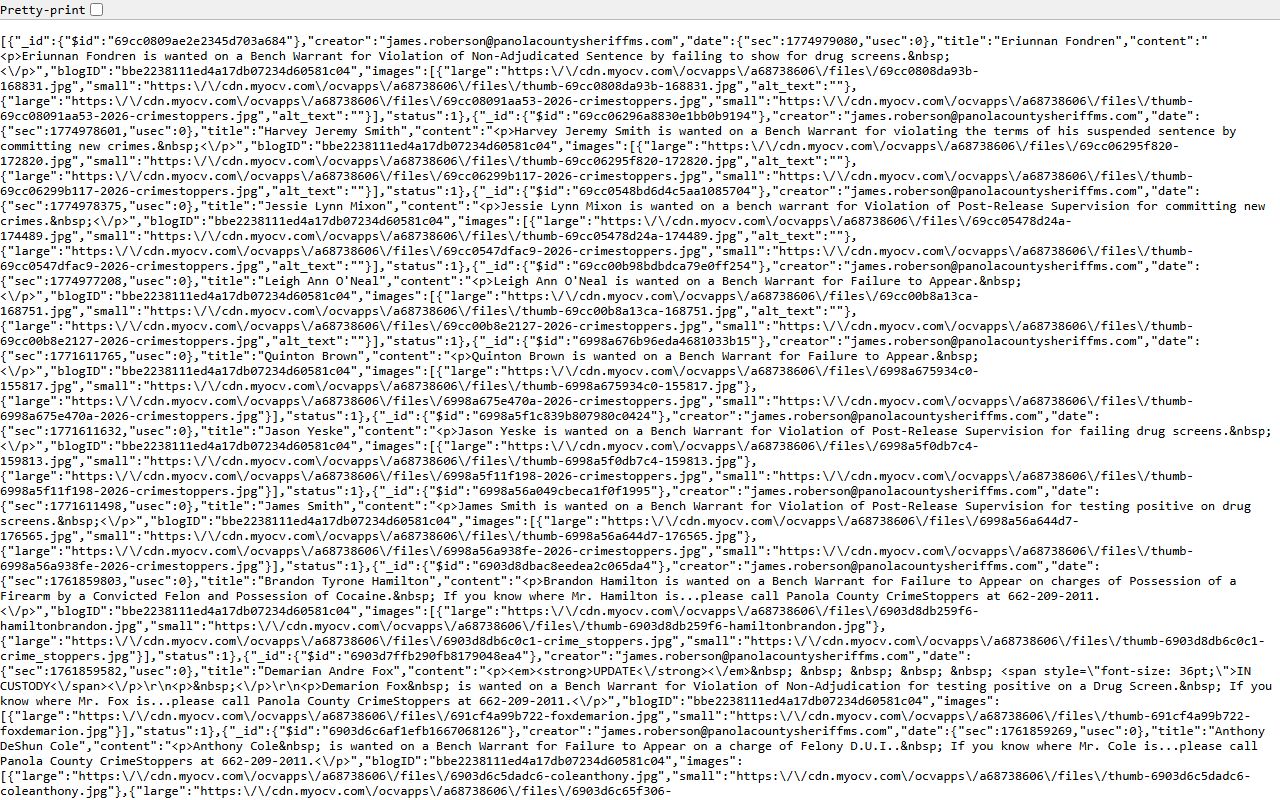
The list names people wanted on warrants such as violation of a non-adjudicated sentence, violation of a suspended sentence, and violation of post-release supervision. It is an app-only feature and not a full warrant database, so an active warrant can exist without appearing on it. The full app is reached through the Sheriff's app share link, and Crime Stoppers of Panola County takes tips at 662-209-2011.
Charge Status and What It Means
Charges rarely stay frozen. As a case moves, a prosecutor or judge can amend a charge, reduce it, add a count, drop it, or dismiss it. The status shown in the court record tells you where each charge stands at that moment, which is why one entry can look very different from the booking charge that started it.
| Status | What It Means |
|---|---|
| Pending | The charge is filed and the case is still open with no final outcome yet. |
| Amended / Reduced | The charge was changed, often to a lesser offense, by the prosecutor or court. |
| Dismissed | The court dropped the charge, with or without the option to refile it later. |
| Nolle Prosequi | The prosecutor formally chose not to pursue the charge at that time. |
Charge Codes and Severity Levels
Every Mississippi charge ties to a statute, and the charge code is that statute's number. The code tells you exactly which law the charge falls under and helps separate a felony from a misdemeanor. One arrest can produce several separate charges, each with its own code and severity level.
- 97-3-7(4)
- Aggravated domestic violence, a felony-level assault charge.
- 97-17-43
- Petit larceny, a theft charge tied to the value of the property.
- 63-11-30(2)(a)
- Driving under the influence, first offense, set out in Mississippi Code Section 63-11-30.
- 47-7-37
- Probation violation, which can return a person to court or to custody.
Severity drives where a charge is heard. Misdemeanors stay in Justice Court or municipal court, while felonies move to Circuit Court for prosecution by the District Attorney.
Charges vs. Convictions
Being charged is not the same as being convicted, and the distinction matters for anyone reading an arrest or charge record. A charge is an accusation. A conviction is the outcome reached after a plea or a verdict. A record can show a charge that was later dismissed, reduced, or never proven, so the charge alone does not establish guilt.
| Charge | Conviction | |
|---|---|---|
| Stage | Accusation | Verdict or plea |
| Burden of Proof | Probable cause | Beyond a reasonable doubt |
| Means Guilt | No | Yes |
| Public Record | Yes | Yes |
Statewide Charge and Criminal History Lookups
Mississippi does not offer one free public portal that compiles a person's full criminal history. A few official tools cover slices of it. The Mississippi Department of Corrections runs an inmate search for people in state custody, where you can look up a name or MDOC identification number. The Department of Public Safety issues an official driver record that shows traffic charges and convictions tied to a license. For most county charges, the Circuit Clerk and the Mississippi Electronic Courts system remain the authoritative source.
Sealed vs. Expunged Records
Some charge records leave ordinary public view. Mississippi law lets eligible records be expunged, and certain matters are sealed by statute. A sealed record is hidden but still exists; an expunged record is treated as though the charge never happened.
| Sealed | Expunged | |
|---|---|---|
| Visibility | Hidden from public view | Treated as if it never existed |
| Law Enforcement | Limited access | Very limited access |
| Eligibility | Set by statute for youth court and other protected filings | By petition under Section 99-19-71 for qualifying cases |
Background Check Considerations
Casual record lookups and formal background checks are not the same thing. Reading a public charge record for personal knowledge is different from screening someone for a job, an apartment, or credit. Those decisions fall under the federal Fair Credit Reporting Act and must run through a compliant provider that follows its rules.
Important: A public charge record is not a consumer report under the FCRA and cannot be used for employment, housing, credit, or insurance decisions.
Restricted Charge Records in Panola County
Not every charge record is open. Youth Court records and records involving children are confidential under Mississippi Code Section 43-21-251, so juvenile charges are not treated like ordinary public records. Charges tied to an ongoing investigation may be withheld until the case develops. Dismissed or expunged charges can be removed from the public version entirely. The Mississippi Public Records Act presumes records are open, but the office that holds a file decides whether a specific charge record is public, redacted, sealed, or available only by court order.